
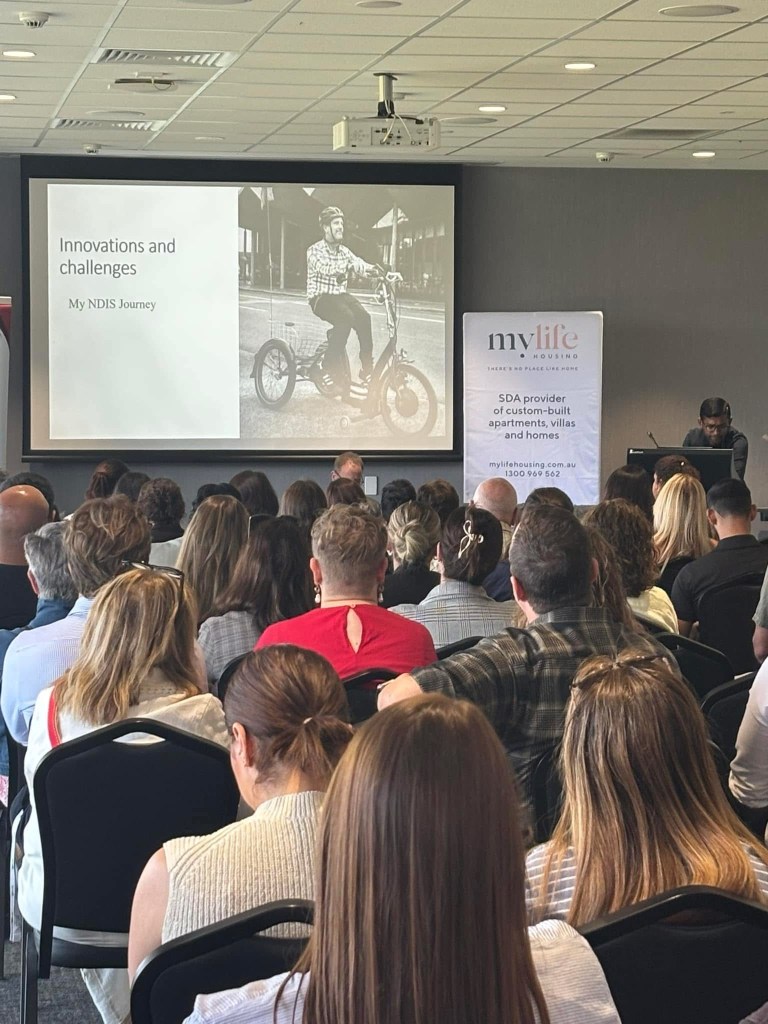
I was recently invited to speak at the Inner West Disability Forum to contribute to discussions about updates to the NDIS. I was lucky to speak alongside Anita from Self Manager Hub who are really leading the way in community information sharing and advocacy at a time of great change.
A representative from the NDIA was also due to speak but, perhaps unsurprisingly, was unable to attend. I was disappointed as I would have liked them to hear what we had to say. But as a result, I had more time and my talk included a few more examples of low-cost ways I’ve used my funding to make inexpensive but big changes in my life.
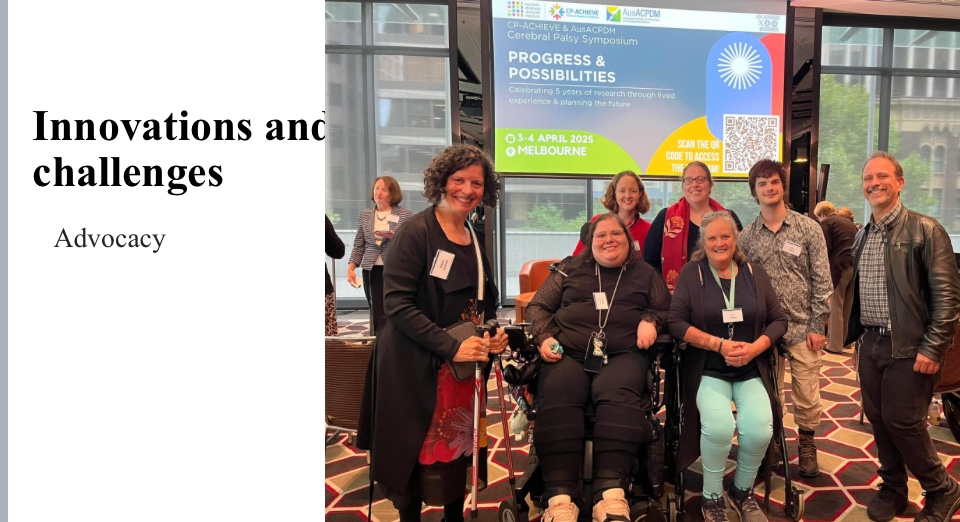
I also highlighted the importance of peer, support and peer led advocacy something that my wonderful friends in Tribe do so well together. You can see some of us pictured at the recent CP Achieve Conference in Melbourne below.
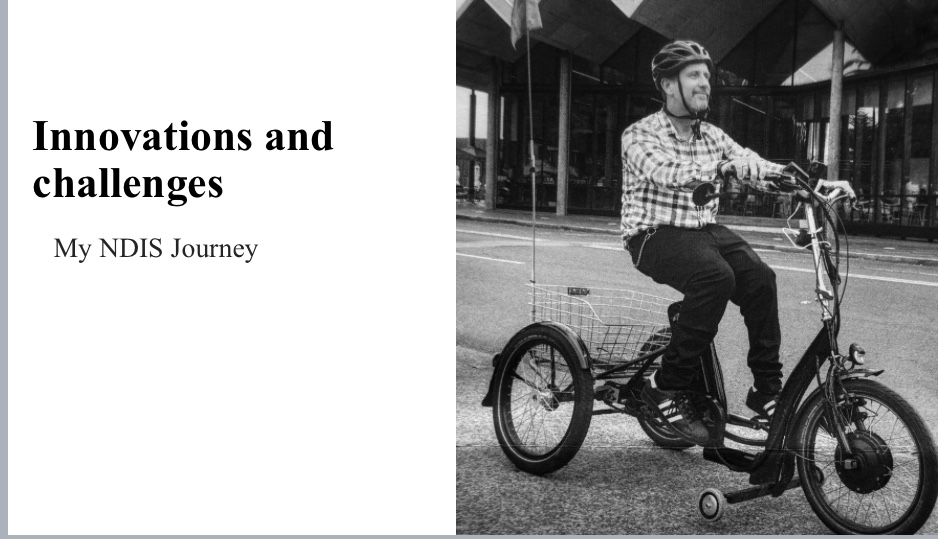
Of course, my slides featured gratuitous images of me and my trike. (Not pictured me falling off a chair in the later part of the morning!)
I am glad my talk was well-received. Many people there filled out the petition from Every Australian Counts, calling for lived experience and participants’ medical evidence to be considered when reassessing NDIS plans.
I hope the government will listen to the disability community’s call, but I fear a decision may have already been made.
My speech is below.
Innovations and challenges: five years as a self-manageron the NDIS
My name is Finn, and I’ve been a self-managed participant on the NDIS for the past five years.
When I first heard the theme of this forum was about innovations and updates, I have to admit I felt uneasy. The NDIS is at a crossroads. For countless people on the scheme this is a time of great uncertainty and anxiety.
At best, it can feel like reforms are stifling innovation, and at worst, putting lives in jeopardy. And how can I talk about innovation when I feel quite uncertain about my own future under current reforms?
But I passionately believe that when it is working well, the NDIS is life-changing. It has transformed my life in so many ways, and for that I am extremely grateful. I am here today to talk about some of the innovative ways I’ve used my funding to date, and what I am learning about the way forward under the new NDIS rules.
Just weeks before being asked to do this talk, I had reached out to my OT to check if ways I’ve used my low-cost assistive technology budget in the past were still allowed under the new Section 10 rules.
My provider replied, “These are very good questions, but I am no longer able to confidently advise you.” My OT’s response left me wondering: if a registered NDIS provider does not feel confident in interpreting the new rules, what hope is there for a self-manager like me?
The s10 legislation overlays prescriptive “in and out” lists on top of reasonable and necessary criteria and participant goals. All three must now be considered together when making decisions about using NDIS funds. I like to think I’m pretty smart, but I’m no lawyer. And the process of reading two separate lists in conjunction with the s10 legislation leaves my head spinning.
I contacted my LAC, who confirmed that many of the ways I’ve successfully used my low-cost AT over the past five years may now be viewed as ‘everyday items’. But when I explained my rationale – in particular that the examples not only increase my independence, they are also three times cheaper than using a support worker or paying for a higher-priced disability support – she sounded convinced. But ultimately, it will be up to a planner to decide.
So I think our job now, to continue to innovate, is to work harder than ever to provide clear, irrefutable evidence with our OTs, physios, and other health professionals to keep advocating for what we know works.
Because I think it’s crucial that, during this period of reform, we don’t lose sight of the heart of the scheme as it was intended. Decisions about supports must remain grounded in lived experience – not only economic rationalism – because the NDIS should be seen for what it truly is: an investment in people’s lives.
Today I’m sharing my story to show how I’ve used a modest NDIS package in innovative ways to support my independence and improve my life. And how I’ve successfully advocated for what I need.
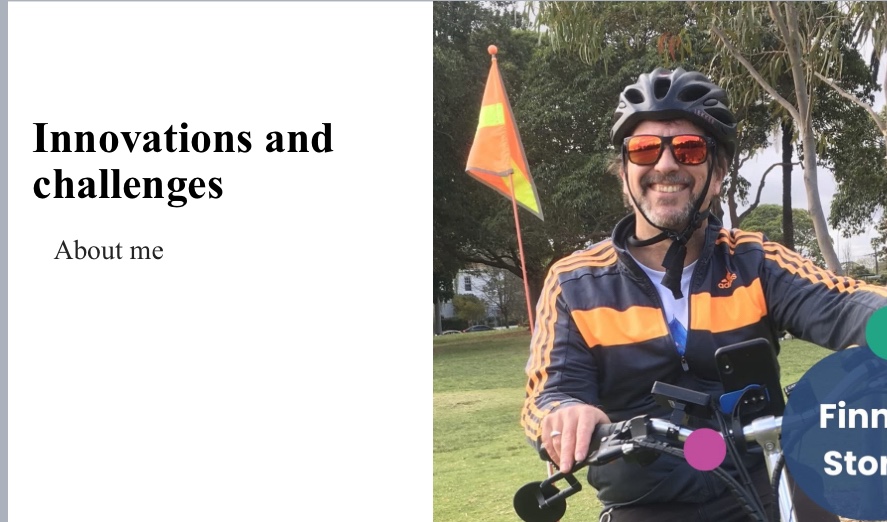
About Me / Background
I was born prematurely with cerebral palsy and I’ve had a lifetime of care in the public health system. Costs which have never be questioned or scrutinised.
I’ve been in physio since I was a child, and by my teenage years, I had undergone numerous operations to improve my mobility. I’ve had a wonderful life with lots of opportunities.
When I turned 18, I left the paediatric health system. And it might surprise you to learn that although cerebral palsy is one of the most common childhood-onset disabilities, accessing care and support as an adult with CP is actually very hard.
For most of my adult life, I’ve paid out of pocket for my healthcare — physio, osteo, X-rays, podiatry, doctors’ visits.
As I aged, my gait was changing, and as well as mounting medical costs, I was wearing out my shoes every six weeks. Although I have always worked full time, paying for all this was becoming unmanageable.
About five years ago someone I met suggested I apply for the NDIS. I knew very little about it.
My First Year on the NDIS
Someone once told me that applying for the NDIS is like applying for a driver’s licence. You won’t get it on the first go. And so it was that after about 12 months and two attempts, my access request was accepted.
My first NDIS plan was nothing short of transformative.
For the first time since I was a teenager, I was able to resume weekly physio, which had a big impact on managing chronic health issues and improving my posture and how I walk. I worked with an exercise physiologist at the gym to build onthese gains, focusing on increasing mobility, balance, and flexibility.
And I got a modified trike, which changed my life in every way.
To get my trike was a lot of hard work. It took 18 months and another review request.
When I got a letter back from the Agency saying my trike was deemed to be reasonable and necessary, it was one of the best days of my life.
My trike has completely changed the way I live. I use it to get my shopping, take shirts to the laundry to be ironed, and get around my community — no support worker required, just pure independence, and sorry if this is not deemed reasonably and necessary, it’s a lot of fun too!
In fact, my passion for cycling has developed into a side career. I’m now a co-investigator on a multi-year study exploring cycling opportunities for young people with disability, with published papers and opportunities to speak at research conferences – no PhD required!
Another thing that has been incredibly helpful is my Apple Watch SE. Far from being a luxury item, it proved to be far cheaper than other falls detection pendants. I use it not only for falls alerts, it helps be me do home stretching and exercise, controls smart lighting in my home, communicates in an emergency.
I understand that the purchase of a non-cellular Apple Watch now falls under the new ‘replacement item’ category. To be honest, I’m not sure what I’d tell the NDIA it replaces because it does so much.
But it was the best $400 I ever spent. There’s on ongoingsubscription fee, and it hasn’t missed a beat in four years. Tell me that’s not beneficial and value for money! But I’m not I’ll be allowed to get another one using my funds.
These are just a couple of the many low-cost supports that have a huge impact on my life and wellbeing.
My AAT Appeal
After my first year on the NDIS, my plan was slashed in half.
I appealed and received an impersonal pro-forma letter explaining all the reasons my request for review was denied:
• “No evidence that the supports are beneficial or effective”
• “Not value for money”
• “Duplication of supports”
They even had the gall to suggest that instead of my monthly podiatrist appointment to maintain my ability to walk, my husband, who does not have an allied health qualification,could do it.
So I went down the path of appealing at the AAT. I compilednumerous reports and a lived experience statement.
After nine months of case conferences — up against a top-tier lawyer hired by the NDIA — I finally received a one-line email:
“The NDIA has determined the supports you are requesting are reasonable and necessary.”
Since then, my plan has continued unchanged.
This experience was harrowing, but it made me realise how critical it is to fight for fair, evidence-based decisions. And the role of clear evidence to advocate for what you need.
Looking Ahead
As I move onto the new NDIS PACE computer system next year, My LAC has advised me that the level of flexibility I have under my current plan will change, and all of my supports need to be listed as Stated Supports in my plan.
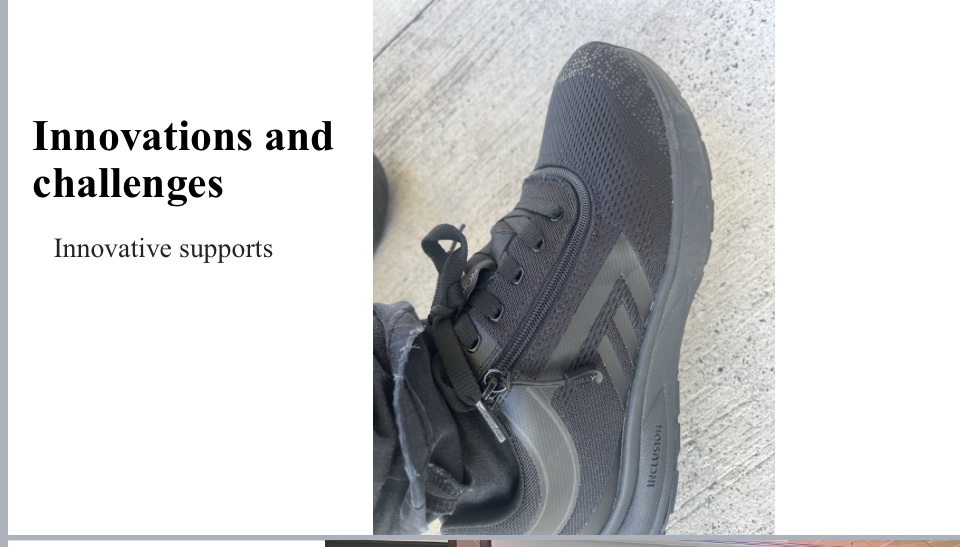
Simple low-cost items that my lived experience has clearly shown to help me function — like shoes I can remove withouthelp, repairs, or my trike, or even the right socks — could be dismissed as everyday expenses.
And if that happens, I’ll be pushed into more costly supports from disability suppliers or into using support workers. More cost to the scheme. Less independence for me.
So my challenge — and the challenge for everyone in this room — is to make a strong case about every item that thepeople you are supporting tell you they need. To persuade planners that innovative and effective, disability-relatedsupports are not everyday expenses.
Making these arguments is time-consuming and exhausting. But it’s an opportunity to show that participant-led innovation is both effective and affordable. And that preventative health care saves us all money in the long run.
What worries me now is that the system is moving away from listening to the lived experience of people with disability and our expert health care teams.
Legislative changes mean that the NDIA may no longerconsider any external medical evidence by GPs, OTs or physios, or lived experience statements when conducting needs assessments.
Government-appointed assessors with little-to-no knowledge of who we are as individuals and who may have no expertise in our specific disability, will be making decisions that will greatly impact our lives.
That’s not what the NDIS was meant to be. It was meant to be person-centred, grounded in individual needs, and focused on what works.
Because when people with disability have choice and control to access supports that we know work, that is true innovation.
Thank you.
 TrikeBoy
Leave a comment