Changes to e-bike laws in NSW risk turning your friendly neighbourhood TrikeBoy into an accidental outlaw. And now I’m calling for legislative change.
Much research went into finding a trike that I could safely ride, and considerable self-advocacy, engagement with allied health professionals, and report writing followed to get my assistive technology approved by the NDIS.
A central part of my cycling success story is the use of a throttle to propel me forward and up hills without the need for continuous pedalling – something I can’t do consistently because of my cerebral palsy.
Using a throttle is not about convenience or speed, it is a essential factor that enables me to ride.
But recently, I learnt a sobering fact. Since 2020, when I first got my trike, the laws governing the use of e-bikes in NSW have changed substantially (but are not the same in all states and territories).
The impact of the current legislation in NSW is that e-bike riders are required to use”pedal assist” mode to engage the motor above walking speed.
In other words, E-bike riders are legally compelled to pedal continuously when travelling above 6 km/h (walking speed). And if their bike can do this without being pedalled it’s illegal.
But holy ableism, Batman! Not everyone can pedal continuously to make pedal assist work. I am a case in point. Pedal assist creates a safety risk if I need to cross a road quickly when the lights chance, or get up a hill, or negotiate other cars on the road without randomly stalling mid ride.
The unintended consequence of this law I believe discriminates against riders with disability, because:
- A cyclist pedalling a standard bike can travel legally up to 10 km/h on a shared path.
- A cyclist riding an eBike on a shared path can travel up to 10 km/h if they are pedalling continuously using pedal assist mode.
- A person using an electric wheelchair or riding a mobility scooter can travel up to 10 km/h on a shared path.
But an adaptive eTrike user who relies on a throttle to help them pedal when needed not catered for in the above scenario .
Because my bike can go faster than 6 km/h using my throttle (the motor maxes out at 10 km/h or a little above depending on the gradient), my eTrike cannot be lawfully used in the way it was prescribed.
Sure, I could get a mobility scooter and travel legal at the same speed as everyone else , but why shouldn’t I be allowed to do this on a bike!
Is this situation fair? No, I don’t think so. Could it be resolved? Absolutely!
The NSW Parliamentary Inquiry into eBikes and micromobility devices released a 300-plus-page report. Unfortunately, I believe that the needs of people with disability were overlooked in that report.
I have written to Government proposing a simple solution: introduce a medical exemption for people who need to use a throttle to ride safely. Such exemptions already exist for people who need to ride on the footpath for medical reasons, so what I am proposing is not even out-of-the-box thinking. It’s only fair.
I am asking to be treated exactly the same as other cyclists under the law. Why should I be disadvantaged because of disability?
Cap throttle-only use at 10 km/h by all means. The irony is that under current laws riders using pedal assist are legally able to travel at more than double this speed – up to 25 km/h on roads and cycleways. I have no interest in going that fast!
I ride at 10 km/h on shared paths like everyone else, and if I’m on a cycleway or a quiet street, the fastest I go using my throttle is usually around 12 to 14 km/h – that’s more than 10 km/h below the legal limit that able-bodied cyclists are allowed.
(Okay, I’ve ridden down hills faster than that, but that’s thanks to the force of gravity, and last time I checked they hadn’t legislated against gravity yet.)
The picture in this article is of a fellow disabled cyclist I met at a recent NDIS protest, and their placard resonated strongly with me: “Stop criminalising my mobility device.”
I’ve had many instances where I’ve had to explain to security guards that my trike serves the same purpose as a mobility scooter. It looks like a bike, but it’s a mobility device.
With the explosion in the popularity of shared bikes (which I think is a good thing), we have seen increasing legislative crackdowns. And, to mix metaphors, people with disability are being thrown under the bus.
In the current environment, we are seeing eBikes being demonised and restricted in public spaces. Find better places for them to park, and crack down on hooning riders breaking the sound barrier, for sure. But don’t ban eBikes and adative eTrikes from public spaces.
There is a growing body of research recognising that e-bikes are powerful mobility aids for people with disability, and for all people as they age.
People should have the freedom to use the mobility aid of their choice. And all cyclists –able-bodied or otherwise – deserve fair and equal treatment under the law.
I wrote this post several months ago and there have now been some important updates. Please see part two in this story: Queensland introduces new laws for adaptive e-bikes – but what’s happening in NSW?
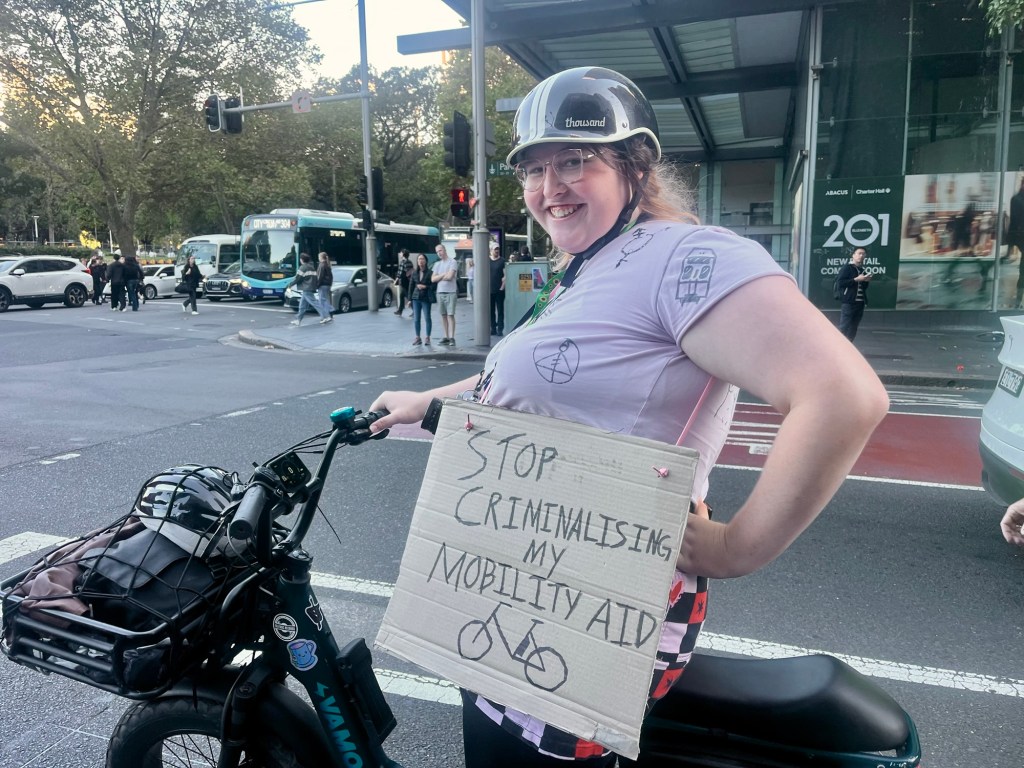
A fellow rider with disability who I met at a recent NDIS reform protest in Sydney Their cardboard placard reads: “Stop criminalising my mobility aid.”


Leave a Reply